
Healthy eyes are essential for a child’s vision to develop properly.
Refractive errors (such as short-sightedness, long-sightedness and astigmatism) and some eye conditions (such as squint, cataract and glaucoma) can interfere with the natural development of the visual system.
To spot vision problems, it is important for children to have their eyes checked by an ophthalmologist from an early age.
When should you take your child to an eye doctor?
-
In the first months of life
- If there are inherited eye problems in the family (for example congenital cataract, childhood glaucoma, squint or severe short-sightedness).
- If you notice specific signs in the eyes: redness, sensitivity to light, heavy watering, a squint, a drooping eyelid, or eyes that look too large or too small.
- If you notice unusual behaviour: a vacant gaze, difficulty following moving objects, difficulty grasping things, frequent falls, or difficulty avoiding obstacles.
-
At three years
When the child starts to cooperate and can tell you what they see.
-
At five to six years
Before starting school, to check that vision is developing normally.
-
At ten to twelve years
When mild or moderate short-sightedness tends to appear.
The children’s eye examination
The ophthalmologist needs to know about your child’s general health: whether they are growing normally, have had any illnesses, take any medicines or have allergies, and whether there were any complications during pregnancy or at birth.
A child doesn’t need to be able to talk for their vision to be assessed.
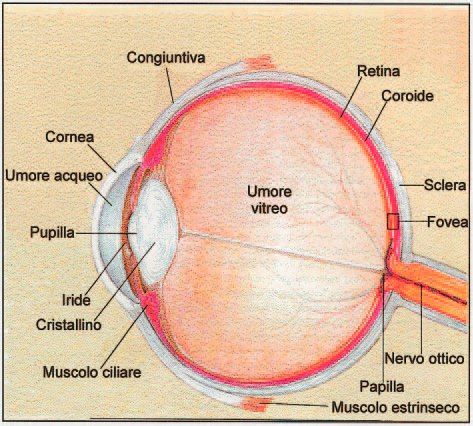
The part children like least, but which is often essential, is dilating the pupils. This lets the ophthalmologist examine the inside of the eye: the retina (which turns light into nerve signals) and the optic nerve (which carries those signals to the brain).
Dilating the pupils also makes it possible to measure refractive errors (short-sightedness, long-sightedness and astigmatism) very precisely.
Common vision problems in childhood
Short-sightedness (myopia)
The eye is longer than normal, so images are focused in front of the retina and look blurred. A short-sighted child sees better close up than far away.
Long-sightedness (hyperopia)
The eye is shorter than normal, so images are focused behind the retina and look blurred.
If the problem is mild, however, a muscle inside the eye can make up for it by changing the curvature of the lens, so glasses aren’t needed.
Astigmatism
The front surface of the eye (the cornea) is not perfectly round, so images are blurred both close up and far away.
Amblyopia (“lazy eye”)
Vision fails to develop properly in one or both eyes.
Amblyopia is easier to correct if it is diagnosed by the age of three or four. If it is diagnosed later in childhood, it may no longer be correctable.
Any problem with the eyelid or the eye that stops a sharp image forming on the retina can cause amblyopia.
Squint (strabismus)
The eyes are not aligned: one eye points in a different direction from the other.
At birth the balance of the eye muscles is unstable, and in the first months the eyes may sometimes wander; this is nothing to worry about if it is only temporary. When both eyes look in the same direction, normal binocular vision develops, which gives three-dimensional perception.
When one eye turns, the brain receives two different images, causing double vision (diplopia). To avoid this, the brain tends to suppress the image coming from the turned eye. As a result only the straight eye develops properly, while the turned eye stays underdeveloped (lazy eye).
Congenital cataract
A cataract is when the lens of the eye loses its transparency. In adults a cataract is not urgent, but in children it prevents the eye from developing normally.
Congenital cataract has various causes: infections passed from mother to baby during pregnancy (toxoplasmosis, rubella, cytomegalovirus), medicines, metabolic diseases, ionising radiation and genetic abnormalities.
Treatment is surgical, and the earlier the operation, the better the result. A long period of rehabilitation is still needed afterwards.
Congenital glaucoma
Glaucoma is caused by raised pressure of the fluid inside the eye (the aqueous humour), which damages the optic nerve and reduces vision, first at the edges and later in the centre.
It is hard to diagnose in the early stages, but over time symptoms begin to appear, such as heavy watering, an enlarged eye and strong sensitivity to light.
Left untreated, the disease leads to blindness; surgery is almost always needed.
Download the original leaflet (PDF in Italian, 240 KB).
References
Jack J. Kanski, Oftalmologia Clinica (Italian edition of Clinical Ophthalmology), translated by Guido R. Mastellone, USES, Florence, 1990.
D.J. Spalton, R.A. Hitchings, P.A. Hunter, Atlante di Oftalmologia Clinica (Italian edition of Atlas of Clinical Ophthalmology), translated by Guido R. Mastellone, UTET, Turin, 1995.
This page is for general information and is not a substitute for a medical examination.